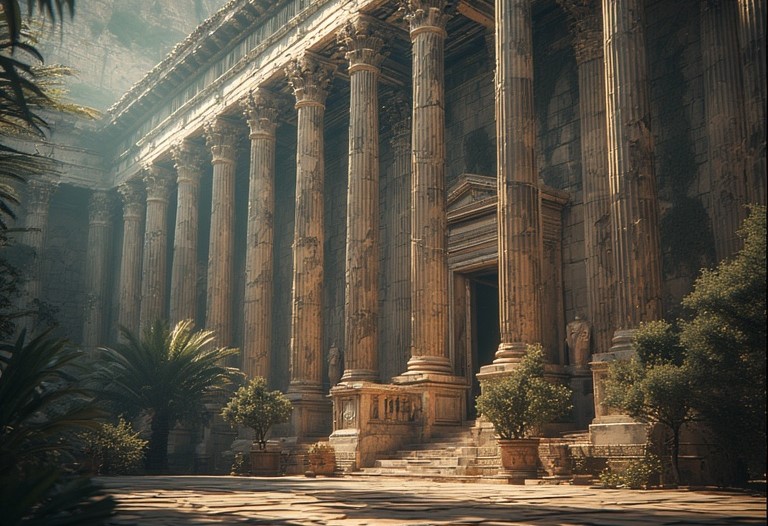
In the bustling port city of Alexandria, once the jewel of the Mediterranean, a dream took physical shape: a library that would hold the sum of all human knowledge. The ancient Library of Alexandria was more than a collection of scrolls — it was a beacon of learning, a meeting place for the brightest minds of the ancient world, and part of the Mouseion, a sanctuary devoted to the Muses.¹
Legend tells of Demetrius of Phaleron, under the patronage of Ptolemy I, orchestrating the city’s transformation into a hub of scholarship.² Ships docking in Alexandria were reportedly searched for books. If a book was found, it was either returned or a copy was made on the spot, with appropriate compensation to the owner. Books acquired in this way were designated as "from the ships."³
At its height, the Library may have housed hundreds of thousands of scrolls, recording the discoveries, philosophies, histories, and mathematics of civilizations across the known world.⁴ Its halls were designed not only for storage but for discourse and contemplation, drawing scholars, philosophers, and astronomers from across the Mediterranean and beyond. The Mouseion and the Library together functioned as an intellectual nucleus, where knowledge was revered as both a public and private pursuit. The exact architectural details of the ancient Library are not fully known, but it was designed to support study, debate, and the preservation of scrolls rather than to reflect a modern structural design.
The Library’s history is intertwined with legend and the ambitions of rulers. Cleopatra VII, the famous last Pharaoh of Egypt, is often associated with Alexandria’s intellectual life. Stories suggest that she patronized the Library and its scholars, seeking knowledge that could strengthen her rule. Though direct evidence of her involvement remains sparse, her reign symbolizes the city’s golden age of learning.⁸ The presence of Cleopatra in this narrative illustrates how political power and scholarship were often connected — the pursuit of knowledge served not only minds but also ambitions, dynasties, and diplomacy.
When Islamic armies entered Alexandria in 641 AD, historians sometimes mention Caliph Umar ibn al‑Khattāb's role, although sources disagree about how much direct impact he had on the library.⁹ Scholars today debate these reports, noting that the destruction of the Library likely occurred gradually over centuries rather than in a single event.¹⁰ This nuanced perspective underscores the tensions between knowledge, preservation, and the shifting sands of political power. The Library, in its decline, became a symbol of both the fragility and the enduring spirit of human curiosity.
Despite its eventual demise, the Library’s influence endured. Knowledge once gathered there filtered through other centers of learning across the Islamic world and Europe, forming the intellectual foundation of centuries to come. The stories, myths, and fragments of scrolls left behind inspired generations of scholars and rulers, leaving an indelible mark on history.
Centuries later, a modern incarnation emerged: the Bibliotheca Alexandrina, inaugurated in 2002.¹¹ Designed as a tribute to the ancient vision, it is a hub for research, culture, and global exchange. The Library’s architecture, with its impressive circular reinforced diaphragm wall, reflects its mission of connecting past, present, and future.⁷ Here, scholars can access millions of books, digital archives, and exhibition spaces, continuing the pursuit that began thousands of years ago. The institution also houses museums, a planetarium, and art galleries, reflecting the Library’s historical role as a center not just for texts, but for all forms of knowledge.
Walking through its halls today, one cannot help but feel the echo of history. The ancient Library may be gone, but its dream endures. From Cleopatra’s ambitious patronage to the debates under Islamic rule, the story of Alexandria’s Library is not just about scrolls or architecture — it is about humanity’s ceaseless quest for understanding, the preservation of wisdom, and the power of ideas to transcend time and politics. Knowledge once sought is never truly lost; it simply waits for the next generation of seekers to rediscover it.
The Library of Alexandria remains a reminder that curiosity is both fragile and enduring, that even in the face of destruction, knowledge inspires resilience. It teaches us that civilizations are measured not only by power and conquest, but by the treasures of the mind they choose to create, protect, and pass on. In this way, Alexandria’s lost wonder is alive not in stone or scrolls, but in every library, university, and scholar who continues the quest to understand the world.
https://www.britannica.com/topic/Library-of-Alexandria/The-fate-of-the-Library-of-Alexandria
https://www.britannica.com/topic/Bibliotheca-Alexandrina-research-institution-Alexandria-Egypt
https://www.bibalex.org/attachments_ar/Publications/Files/EnglishBrochure.pdf
Library of Alexandria - Ancient, Burning, Destruction | Britannica